Agents running,
while you sleep
Cosine in the cloud keeps work moving after your local environment runs out of time, context, or attention.
Four Modes. For Every Kind of Work.
From scoping work to autonomous execution, you can choose how much oversight you want and switch modes as the task evolves.
Every surface gets better when the platform exists underneath it.
Escape velocity for long-running work
Everything that happens after local runs out
The platform is the layer between your machine and infinite scale. Remote execution, parallel agents, cross-device continuity, and approval-gated actions.
Parallel agents
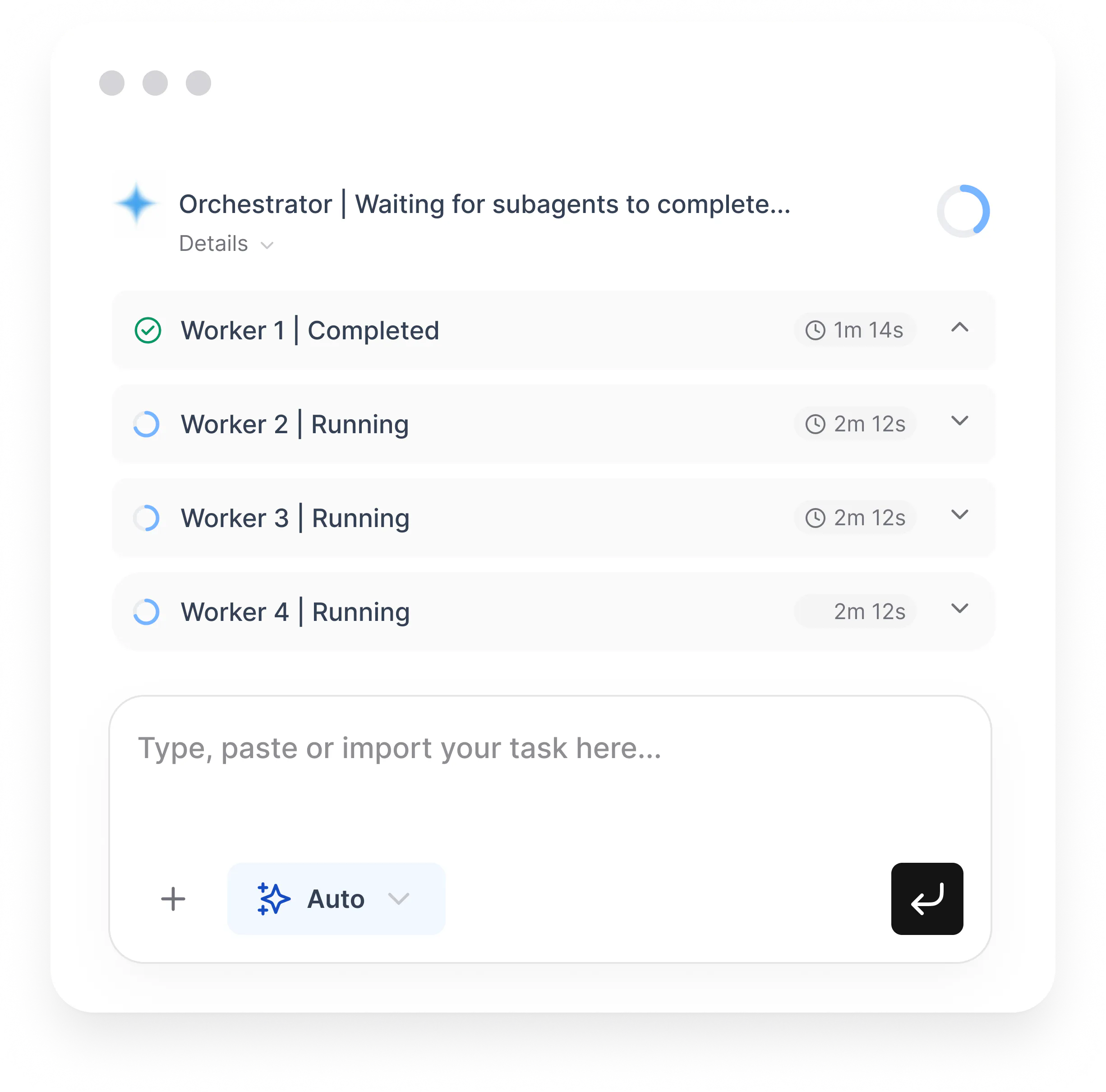
Run 20+ agents simultaneously on isolated worktrees. They work in parallel with zero coordination overhead — no merge conflicts, no shared state. Everything resolves before you see a diff.
Your machine as a node
When the CLI or Desktop is running, your machine is part of the Cosine network. Start a task on your laptop, continue it from your phone. The work keeps running — on your hardware, with your files.
Approval-gated actions
Read operations are automatic — indexing, fetching, monitoring. Write operations only go out when you say so. Push code, send a Slack message, file a PR comment — one confirmation, then it executes.
Remote execution
Agents run on isolated platform workers or your own SSH targets. Kick off a complex refactor, board a flight, and come back to a finished diff. No babysitting required.
MicroVM isolation
Every agent session runs in a hardware-isolated MicroVM — the same technology that powers AWS Lambda. ~125ms boot time. Dedicated kernel. Secure by default, not as an afterthought.
Model-agnostic
Codex, Sonnet, Opus, Kimi K2.5, Minimax, GLM, Gemini. Bring your ChatGPT subscription. The platform doesn't lock you to any provider — your results shouldn't depend on a single model.
Parallel agents
Run 20+ agents simultaneously on isolated worktrees. They work in parallel with zero coordination overhead — no merge conflicts, no shared state. Everything resolves before you see a diff.
Your machine as a node
When the CLI or Desktop is running, your machine is part of the Cosine network. Start a task on your laptop, continue it from your phone. The work keeps running — on your hardware, with your files.
Approval-gated actions
Read operations are automatic — indexing, fetching, monitoring. Write operations only go out when you say so. Push code, send a Slack message, file a PR comment — one confirmation, then it executes.
Remote execution
Agents run on isolated platform workers or your own SSH targets. Kick off a complex refactor, board a flight, and come back to a finished diff. No babysitting required.
MicroVM isolation
Every agent session runs in a hardware-isolated MicroVM — the same technology that powers AWS Lambda. ~125ms boot time. Dedicated kernel. Secure by default, not as an afterthought.
Model-agnostic
Codex, Sonnet, Opus, Kimi K2.5, Minimax, GLM, Gemini. Bring your ChatGPT subscription. The platform doesn't lock you to any provider — your results shouldn't depend on a single model.
Parallel agents
Run 20+ agents simultaneously on isolated worktrees. They work in parallel with zero coordination overhead — no merge conflicts, no shared state. Everything resolves before you see a diff.
Your machine as a node
When the CLI or Desktop is running, your machine is part of the Cosine network. Start a task on your laptop, continue it from your phone. The work keeps running — on your hardware, with your files.
Approval-gated actions
Read operations are automatic — indexing, fetching, monitoring. Write operations only go out when you say so. Push code, send a Slack message, file a PR comment — one confirmation, then it executes.
Remote execution
Agents run on isolated platform workers or your own SSH targets. Kick off a complex refactor, board a flight, and come back to a finished diff. No babysitting required.
MicroVM isolation
Every agent session runs in a hardware-isolated MicroVM — the same technology that powers AWS Lambda. ~125ms boot time. Dedicated kernel. Secure by default, not as an afterthought.
Model-agnostic
Codex, Sonnet, Opus, Kimi K2.5, Minimax, GLM, Gemini. Bring your ChatGPT subscription. The platform doesn't lock you to any provider — your results shouldn't depend on a single model.
Parallel agents
Run 20+ agents simultaneously on isolated worktrees. They work in parallel with zero coordination overhead — no merge conflicts, no shared state. Everything resolves before you see a diff.
Your machine as a node
When the CLI or Desktop is running, your machine is part of the Cosine network. Start a task on your laptop, continue it from your phone. The work keeps running — on your hardware, with your files.
Approval-gated actions
Read operations are automatic — indexing, fetching, monitoring. Write operations only go out when you say so. Push code, send a Slack message, file a PR comment — one confirmation, then it executes.
Remote execution
Agents run on isolated platform workers or your own SSH targets. Kick off a complex refactor, board a flight, and come back to a finished diff. No babysitting required.
MicroVM isolation
Every agent session runs in a hardware-isolated MicroVM — the same technology that powers AWS Lambda. ~125ms boot time. Dedicated kernel. Secure by default, not as an afterthought.
Model-agnostic
Codex, Sonnet, Opus, Kimi K2.5, Minimax, GLM, Gemini. Bring your ChatGPT subscription. The platform doesn't lock you to any provider — your results shouldn't depend on a single model.
Keep work moving after local runs out.
Cosine in the cloud keeps the same workflow alive across retries, long-running tasks, overnight execution, and shared review.